Cell death and inflammation, a double-edged sword in health and disease
Cell death is essential for maintaining homeostasis. Under healthy, steady-state conditions, around 100 billion (10¹¹) cells per day (or one million per second). However, in pathological contexts, cell death becomes dysregulated: excessive cell death contributes to inflammatory and degenerative diseases, while insufficient cell death is a hallmark of cancer. Our primary aim is to gain an in-depth understanding of both the cell-intrinsic and intercellular mechanisms of cell death and its relationship with inflammation and cancer.
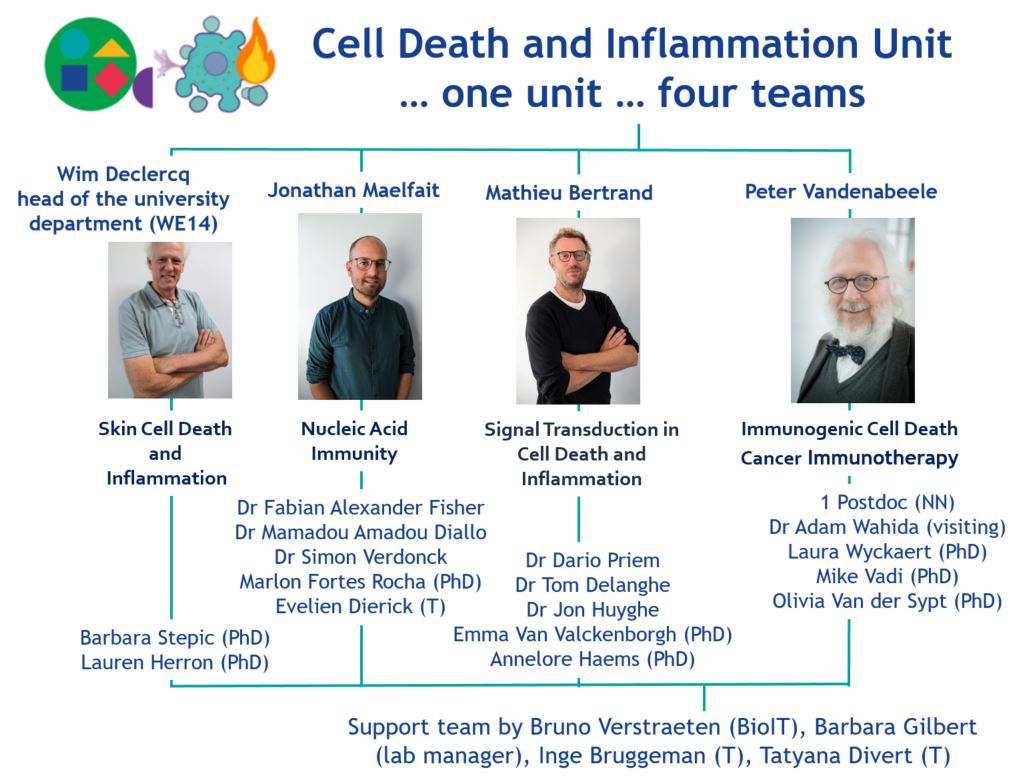
The Cell Death and Inflammation Unit creates a critical mass by bringing together four research teams each addressing interconnected aspects of cell death and its impact on inflammation, cancer, infection, and immune regulation. Together, these teams aim to generate fundamental insights into cell death mechanisms and translate them into therapeutic strategies (https://belgian-research.eu/cell-death-and-inflammation-unit-a-double-edged-sword-in-health-and-disease/).
The Vandenabeele Team – Immunogenic Cell Death and Cancer Immunotherapy
Focus: How to render ferroptosis immunogenic to enhance cancer immunotherapy.
Key Findings: Ferroptosis is driven by lipid peroxidation (LPO) and induces immunosuppression in cancer cells by interfering in antigen cross-presentation.
Research Goal: To dissect the role of lipid and redox metabolism networks in regulating ferroptosis and radiation sensitivity and immunogenicity, to develop strategies that boost efficacy of immunotherapy.
The Declercq Team – Cell Death and Inflammation in the Skin and Carcinogenesis
Focus: Mechanisms that maintain skin homeostasis in health and disease.
Key Findings: The kinase RIPK4 functions as a tumor suppressor by restraining oncogenic KrasG12D-driven skin tumor growth.
Research goal: To explore whether allosteric activators of RIPK4 can enhance its tumor-suppressive function, offering new therapeutic avenues for skin cancer.
The Maelfait Team – Nucleic Acid Sensing in Cell Death and Inflammation
Focus: The role of nucleic acid sensors in antiviral defense and cellular stress responses.
Key findings: The sensor ZBP1 detects Z-shaped nucleic acids (RNA, DNA) and triggers apoptosis or necroptosis to limit viral dissemination or activate adaptive responses. When dysregulated, these pathways can drive interferon-mediated autoimmune diseases.
Research goal: To provide molecular insights that pave the way for therapeutic targeting of ZBP1-driven autoinflammatory diseases.
The Bertrand Team – Signal Transduction in Cell Death and Inflammation
Focus: Molecular mechanisms that regulate the interplay between cell death, cell survival and inflammation.
Key findings: The team identified several molecular brakes that prevent TNF-mediated cell death, including an unconventional form of autophagy that recognizes cytotoxic complexes and directs them to lysosomal degradation.
Research goal: To characterize and target these regulatory checkpoints, aiming to limit pathological inflammation in autoimmune and inflammatory diseases or to enhance (TNF-driven) killing of cancer cells.
Areas of Expertise
- Signal transduction in cell death and inflammation (a.o. LLPS, condensates)
- Unconventional autophagy in cell death and inflammation
- Transgenic mice for cell death and inflammation
- Experimental disease models in cell death and inflammation
Technology Transfer Potential
- Molecular targets in cell death and inflammation
- Molecular targeting unconventional autophagy, RIPK1, RIPK4, ZBP1
- Molecular targeting of ferroptosis in cancer
Bibliography
- Full bibliography Visit ➚