


Beyaert Rudi
With the rapidly increasing prevalence of autoimmune and inflammatory diseases, understanding the complexity of the underlying signaling mechanisms has become one of the most urgent scientific challenges. We aim to identify new insights in skin and gut inflammation, immunodeficiency, and cancer. For this, mechanistic studies in cellular models are combined with in-depth phenotyping of patients and gene-targeted mouse models.
Major research lines:
(1) MALT1 paracaspase-mediated CBM signaling
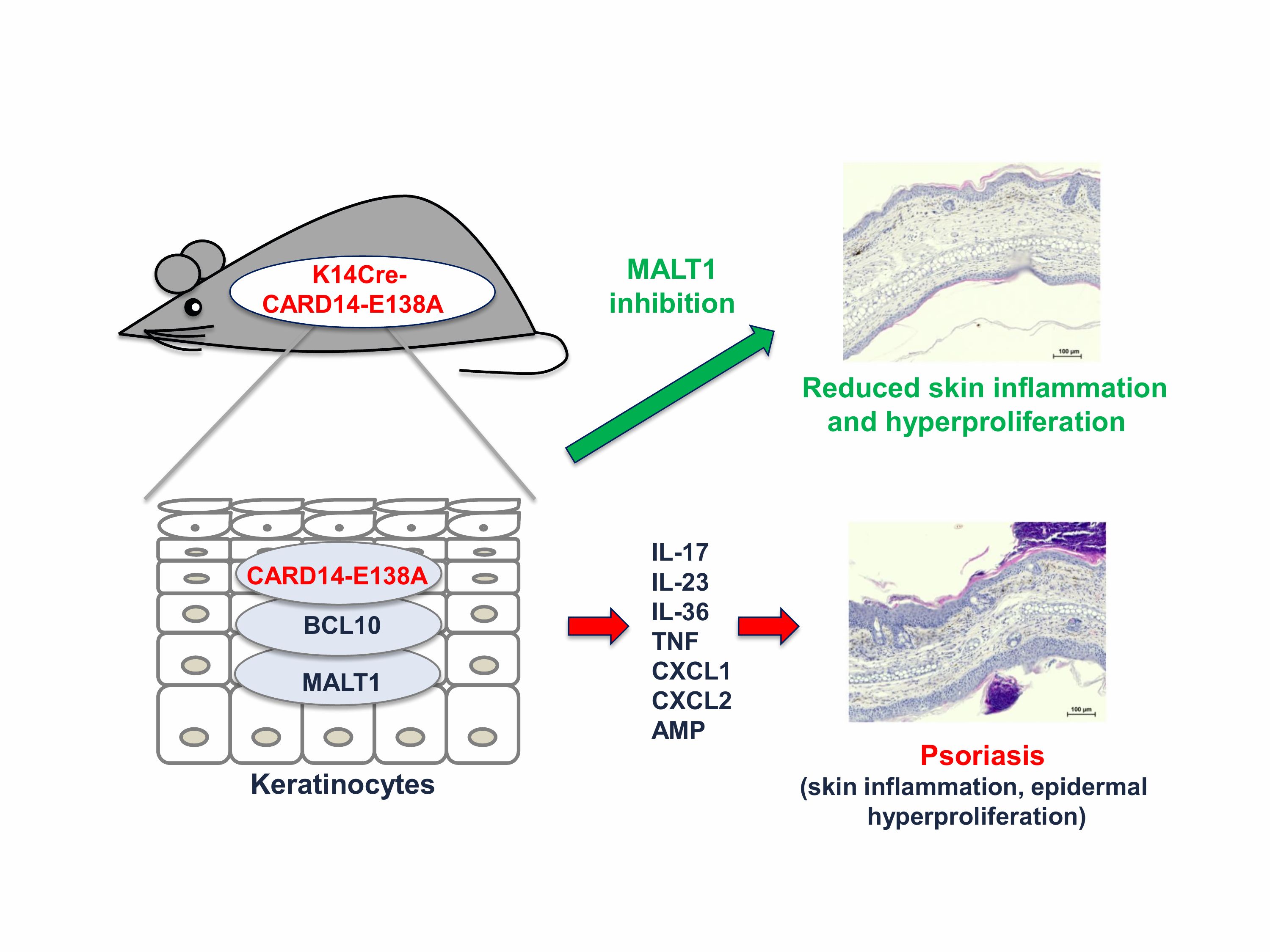
Our discovery that MALT1 holds a unique proteolytic activity in lymphocytes has led to a conceptual breakthrough in the understanding of CBM (CARD11-BCL10-MALT1) complex signaling dynamics and immune regulation (Coornaert et al, Nature Immunol, 2008). Within this complex, MALT1 functions as both a scaffold and a unique protease with a pivotal role in TCR- and BCR-induced NF-κB activation. MALT1 also forms other cell-type specific CBM complexes with CARD11-related proteins (CARD9, CARD10, CARD14), extending its influence to diverse immune and non-immune cells. This broad biological scope opens new avenues for understanding MALT1’s role in health and disease and for therapeutic targeting of MALT1 signaling in inflammatory disease and cancer (Demeyer et al, iScience, 2020). Structure–function analysis in cellular models and detailed phenotypic analysis in newly generated mouse models allows us to study the role of different MALT1 substrates and the effect of genetic variants of CARDx proteins in tissue homeostasis and disease (Skordos et al FEBS J, 2023; Staal et al FEBS J, 2021 and 2024; Iliaki et al., Biochem Pharmacol, 2024; O'Sullivan et al, Biochem J, 2024). In this context, we also showed an important impact of CARD14 genetic variantsin epithelial cells on the development of skin and intestinal inflammatory diseases (Van Nuffel et al, EMBO Rep, 2020) and cancer (Vanneste et al, Biomedicines, 2022).
(2) Inborn errors of immunity as 'experiments of nature'
Inborn errors of immunity, also known as primary immune deficiencies (PID), are a heterogenous group of rare, life-threatening genetic disorders of the immune system that have been associated with ~500 disease-causing genes. Improved functional analysis of genetic defects and immune responses in PID patients allows for the validation of genotype-phenotype effects and provides novel insights in immunity. In the frame of the VIB Grand Challenges project on PID, we developed cell- and murine models for genetic variants of novel and previously known PID genes, and demonstrated their pathogenicity through functional validation (Tavernier et al, Nature Comm, 2019; Naesens et al, J Clin Immunol 2022; Naesens et al, Science Immunol, 2022). Novel insights could also be swiftly translated into new diagnostic and therapeutic solutions for PID patients that have been often overlooked in the past. The inter- and transdisciplinarity of the PID project also leads to structural, long-term collaborations with clinicians, exemplified by the PID 2.0 VIB Grand Challenges validation project. This project sets out to scientifically, technically and clinically validate the interferon score test, its diagnostic/theragnostic utility in different international patient cohorts and develop it into a clinical-grade diagnostic test. Both PID projects are coordinated by Prof. Rudi Beyaert.
(3) Ubiquitin signaling
Ubiquitination plays a crucial role in regulating protein turnover and cellular signaling pathways. Ubiquitin can form different types of chains on target proteins, and these chains can signal different outcomes. We investigate how dysregulation of ubiquitin pathways contributes to inflammation by exploring the role of specific enzymes involved in the ubiquitination (Borghi et al., Biochem Pharmacol, 2018) or deubiquitination (Holgado et al., JACI, 2023) of proteins, and their recognition by ubiquitin-binding proteins. For this, we have also developed multiple conditional gene-targeted mouse models.
Areas of Expertise
- Molecular signal transduction (NF-kappaB signaling, MALT1 signaling, ubiquitination)
- Inflammation and immunity
- Human disease (skin and intestinal inflammation, cancer, immunodeficiency)
- Cytokines
Technology Transfer Potential
- Mouse engineering and modeling of human disease (IBD, intestinal motility disorders, psoriasis, atopic dermatitis, EAE, immunodeficiency)
- Therapeutic targeting of cytokines, cytokine receptors and intracellular signaling proteins (small compound inhibitors, protein engineering, nanobodies, …)
- MALT1 inhibitors
- Assay development
Selected publications
- Holgado, A. et al. A20 is a master switch of IL-33 signaling in macrophages and determines IL-33-induced lung immunity. J Allergy Clin Immunol 152, 244-256 (2023). Visit ➚
- Demeyer, A. et al. Long-Term MALT1 Inhibition in Adult Mice Without Severe Systemic Autoimmunity. iScience 23, 101557 (2020). Visit ➚
- Van Nuffel, E. et al. MALT1 targeting suppresses CARD14-induced psoriatic dermatitis in mice. EMBO Rep 21, e49237 (2020). Visit ➚
- Holgado, A. et al. IL-33trap is a novel IL-33 neutralizing biologic that inhibits allergic airway inflammation. J Allergy Clin Immunol 144, 204-215 (2019). Visit ➚
- Naesens, L. et al. GTF3A mutations predispose to herpes simplex encephalitis by disrupting biogenesis of the host-derived RIG-I ligand RNA5SP141. Sci. Immunol. 7(77):eabq45319 (2022). Visit ➚
Bibliography
- Full bibliography Visit ➚
External links
- VIB Grand Challenges Program - Understanding primary immune deficiencies Visit ➚
- VIB Grand Challenges Program - Understanding primary immune deficiencies 2.0 Visit ➚
- VIB impact stories Visit ➚
- VIB News - Precision oncology company Flindr Therapeutics announces €20 million Series A financing to advance first-in-class small molecule inhibitors Visit ➚
- VIB News - Protecting ourselves from herpes: when trash becomes treasure Visit ➚